When patients ask ChatGPT about dental care, these are the websites it cites most
Key Highlights
- Practice websites now dominate as the primary source for AI-generated dental information, accounting for over 53% of citations in patient questions.
- Specialist areas like orthodontics and periodontics see even higher reliance on practice sites, with over 70% of citations coming from these pages.
- Vague questions tend to lead AI to directories, while specific clinical questions direct the model to detailed practice pages, highlighting the importance of precise content.
- Most practice sites lack detailed, patient-focused content, which limits the AI's ability to cite and influence patient decisions effectively.
- Optimizing your website with comprehensive, clear, and patient-friendly information can significantly impact how AI models cite your practice and attract new patients.
Ask a dentist about their website and you usually hear that it's fine. Someone built it a few years back, it lists the address, hours, and services the practice offers, and it mostly sits there. For years that was a missed search-optimization opportunity and little more. It has quietly become something larger. When a patient asks ChatGPT about dental care, the sources the model reaches for most are not directories or academy rosters. They are the practices' own websites.
We saw this across a large sample. In 1,405 patient-style questions spanning 20 US markets and seven areas of dentistry, practice-owned websites were 53.8% of all the sources ChatGPT cited, more than three times the next-largest category. For dentists, the surface the model leans on most is the one you already control.
Asking the right questions
Why the practice site, and not something else? The contrast with medicine makes it clear. We ran the same study for physicians earlier this year, with the same model and prompts and markets, and there the practice's own website drew only 23.1% of citations, a distant third. The source ChatGPT leaned on most was the hospital-system roster—at 27.1%—with specialty associations close behind.
When a patient asks for a cardiologist, the model answers mostly out of the hospital's "find a doctor" directory and a specialty board's member list, pages the physician does not own and cannot easily change. Many physicians are represented online mainly by institutions they don't control.
Dentistry has no comparable hospital roster. No large employer publishes the dentists' pages, so, unlike in medicine, the citation has nowhere to go, and it lands on the surface that the practice already owns. Physicians are described by pages they do not hold; dentists hold the main page themselves.
This matters because patients are already shifting from traditional search engines to AI assistants. One analysis of SimilarWeb and Statista data put AI tools at roughly a third of US search volume, up sharply year over year.¹ And when AI answers appear inside Google itself, being named in them tracks with who gets the click: Seer Interactive found brands cited in Google's AI Overviews drew about 35% more organic clicks than brands left out.²
One distinction is worth holding on to before going further. The 53.8% is the share of the whole citation pool that lands on some practice's site, not a figure for any single practice. On coverage, 87.2% of the questions we ran cited at least one practice website. The first is about what the source pool is made of, the second about how widely practices show up in it.
The dominance is not an artifact of asking "who's the best dentist near me?" It holds across every area of dentistry we tested, though the height moves in a way we did not predict. We expected the split to track consumer demand: cosmetic and orthodontics, the treatments patients shop for themselves, leaning hardest on practice sites, and referral-driven work like oral surgery and periodontics leaning on academies and directories. The data pointed elsewhere. What moved the number was whether the question named a specific dental specialty.
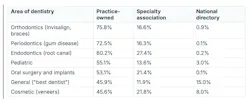
When the question named a specialist, practice websites dominated. Orthodontics came in at 75.8% practice-owned, periodontics at 72.5%, and endodontics at 60.2%. In each case, the model was pulled toward specialist practice pages, with specialty academies taking much of the remaining share.
The vaguer questions sat at the bottom. “Best dentist” and cosmetic veneers both landed near 46%, and the generic query was the one place directories showed up in force, supplying 15% of sources. That makes sense: a question that names no specialty sends the model looking for a list.
Cosmetic dentistry, the field many would assume patients shop hardest, was near the bottom rather than the top. The point is not that cosmetic dentistry matters less online. It is that vague categories invite directories, while specific clinical ones send the model back to the practice’s own pages.
Underneath the variation, the floor is the real story: nothing we tested came in below 45% practice-owned. In the parallel medical study, no specialty reached anything close to 45% practice-owned.
If the model builds its dental answers mostly from practice websites, the lever sits on your own domain. The work is to make each service page actually answer the questions a patient asks about that treatment in the language they use to ask it.
Take implants, for example. A page that reads "We offer dental implants. Call today to schedule a consultation" gives the model almost nothing to quote. A page that explains when an implant is the right option, who is a good candidate, what drives the cost, how long the process takes, and how it compares to a bridge or a denture gives it specific material to work with, and it happens to answer what the patient wanted to know anyway. Most practice sites are closer to the first than the second, and that gap, repeated across implants and root canals and Invisalign and gum treatment, is most of the opportunity.
We also ran a second analysis, comparing the dental practices ChatGPT cites against closely matched practices it never cites, holding market and specialty fixed, to see what separates the two. The difference is not expensive redesign work. It is whether the site gives the model clear, specific, patient-facing material to cite. I will walk through that comparison separately. The finding here is enough to act on: in dentistry, the surface AI leans on hardest is the practice's own domain, and on most sites it is close to blank.
Methodology
A note on method. We ran 1,405 patient-realistic questions through GPT-5.5 via the OpenAI API across June and July 2026, among them "best dentist in [city]," "who does Invisalign," "I need a periodontist for gum disease," and "how much do veneers cost," spanning 20 US metros and seven areas of dentistry (general, cosmetic, orthodontics, oral surgery and implants, periodontics, pediatric, endodontics), with several runs per question to absorb the model's run-to-run variation.
A single answer can cite several sources, so the 13,152 figure counts citation events, not questions, each sorted into a source category using hand-audited rules. The work is single-platform and US-only, so behavior on Gemini, Perplexity, or Google's AI Overviews may differ. It is a snapshot rather than a trend,; it is correlational rather than causal,; and any study that begins from what the model already cites carries survivor bias. The medical comparison draws on a parallel corpus of about 40,000 citations gathered the same way.
References
1. Smith E. AI is much bigger than you think. Graphite. March 2026. Accessed July 8, 2026. https://graphite.io/five-percent/ai-is-much-bigger-than-you-think
2. Seer Interactive. AIO impact on Google CTR: September 2025 update. November 4, 2025. Accessed July 8, 2026. https://www.seerinteractive.com/insights/aio-impact-on-google-ctr-september-2025-update